


Key Takeaways
- Attorneys who delegate case coordination to a virtual case manager recover an average of 5+ hours per workday that were previously lost to non-billable tasks (Clio 2024 Legal Trends Report).
- Virtual case managers improve client retention by keeping communication consistent, proactive, and professional throughout the life of every matter.
- Firms that add a dedicated remote case manager cut staffing overhead by up to 60% compared to an in-house equivalent hire.
- Virtual Staffing places trained, U.S. Law Experienced virtual case managers within 2 to 3 business days at flat-rate pricing with no hidden fees.
Most law firms do not have a caseload problem. They have a capacity problem. The cases are there. The clients are there. What is missing is the operational support to move every matter forward without pulling attorneys away from the work that actually generates revenue.
A virtual case manager is the direct solution to that gap. They take ownership of the coordination layer of your practice: intake, records, client communication, deadline tracking, and documentation. All of it handled remotely, reliably, and at a cost that makes the return on investment easy to calculate.
This article breaks down the specific, measurable ways a virtual case manager improves your firm and how Virtual Staffing places trained professionals who are ready to create that impact from day one.
The Real Cost of Not Having a Case Manager
Before we get into the benefits, it is worth understanding what the absence of dedicated case management is actually costing your firm right now.
According to the Clio 2024 Legal Trends Report, the average attorney bills just 2.9 hours out of every 8-hour workday. The remaining five-plus hours go to coordination tasks like client status calls, document chasing, scheduling, and record requests that honestly do not require a law license to complete.
At a $300 hourly billing rate, recovering even half of the time attorneys spend on administrative work can represent approximately $150,000 in annual billable capacity per attorney. .
That is not a staffing cost. That is a revenue leak. And a virtual case manager is how you close it without adding the overhead of a full-time employee.
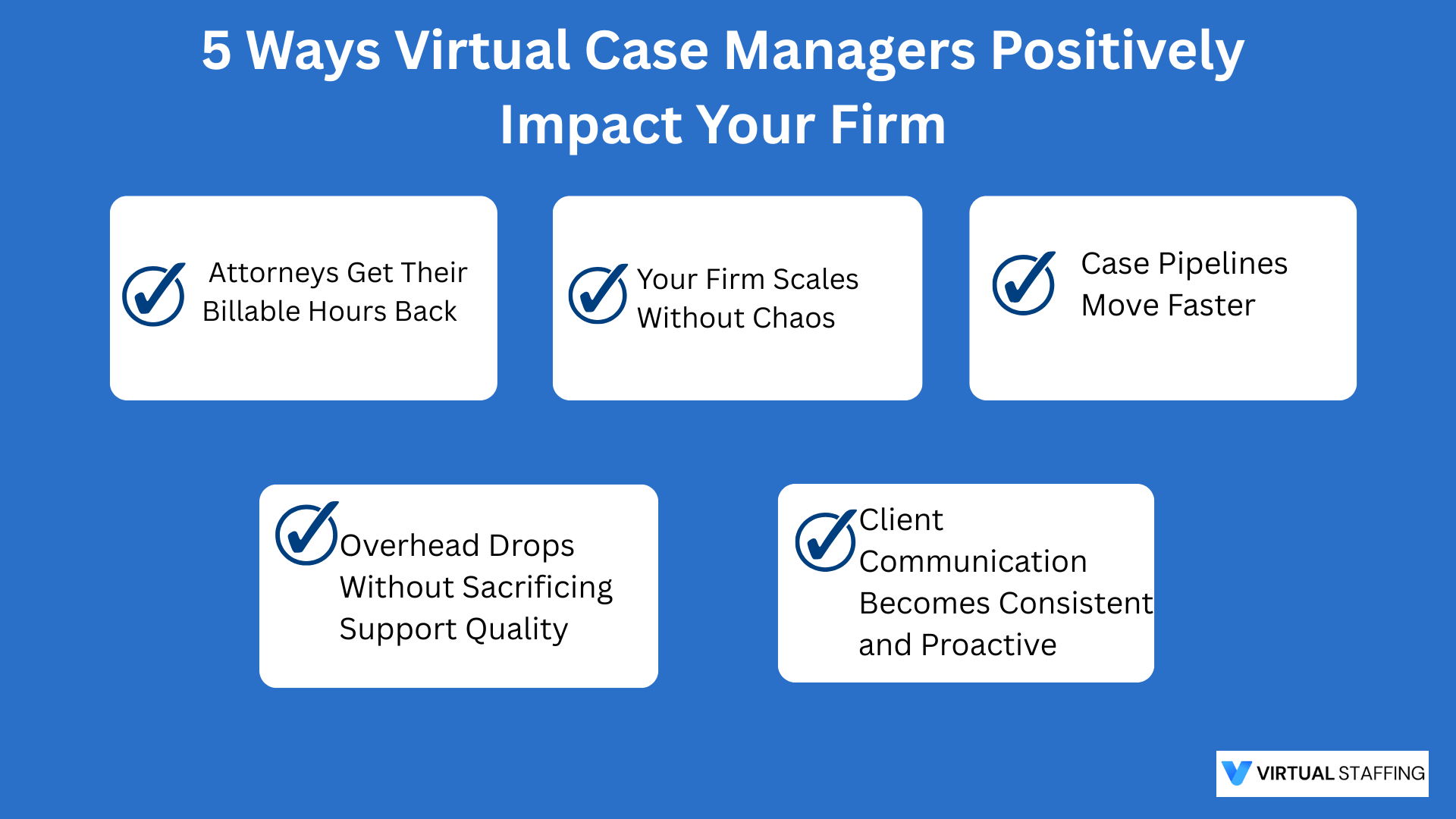
5 Ways Virtual Case Managers Positively Impact Your Firm
1. Attorneys Get Their Billable Hours Back
This is the most direct impact and also the simplest to measure. When a virtual case manager takes ownership of coordination tasks, attorneys stop losing half their day to non-legal work.
Here is what leaves an attorney's plate right away:
- Medical record requests and follow-up
- Insurance correspondence
- Client status update calls
- Court date and deadline reminders
- Case file organization and document retrieval
Each of those tasks might take 15 to 45 minutes on its own. Across a full caseload, they add up to hours. Handing them off to a dedicated virtual case manager is the most straightforward way to recover attorney capacity without hiring another lawyer.
2. Client Communication Becomes Consistent and Proactive
One of the biggest drivers of negative client reviews has nothing to do with losing a case. It is clients feeling ignored while the case is still active. When people do not hear from their firm, they assume the worst.
A virtual case manager fixes this at the structural level. Instead of client outreach happening whenever an attorney finds a spare moment, it happens on a schedule. Status updates, appointment confirmations, document requests, and check-ins are all handled by a dedicated professional who knows your clients by name.
The result is stronger client satisfaction, better online reviews, and higher referral rates. All of that directly affects firm revenue without requiring any additional legal work from your attorneys.
3. Case Pipelines Move Faster
Delays in case progression are almost always operational, not legal. A missing record. An unreturned call. A form that nobody sent. These bottlenecks slow settlements, stretch timelines, and wear on clients.
A virtual case manager tracks every active matter from intake to resolution. They catch what is stuck, follow up on what is pending, and make sure nothing sits idle longer than it should. For personal injury and workers' compensation firms managing hundreds of open matters at once, that kind of operational consistency is what separates high-volume firms from overwhelmed ones.
4. Overhead Drops Without Sacrificing Support Quality
Hiring an in-house case manager in a U.S. market means paying between $50,000 and $70,000 in base salary before you factor in benefits, payroll taxes, office space, equipment, and PTO. The all-in annual cost usually lands somewhere between $75,000 and $95,000.
A full-time trained virtual case manager placed through Virtual Staffing delivers the same dedicated daily support at flat-rate pricing, with no benefits overhead, no office footprint, and no equipment cost. Firms consistently report cost reductions of up to 60% compared to local equivalent hires.
That savings does not come with a quality trade-off. It comes from a smarter staffing model.
5. Your Firm Scales Without Chaos
Growth creates operational strain before it creates revenue. More cases means more records to chase, more clients to update, and more deadlines to track. Without dedicated case management in place, that strain lands directly on your attorneys.
A virtual case manager absorbs that load as it grows. And because placement through Virtual Staffing happens within 2 to 3 business days, firms can respond to caseload increases without sitting through 60 to 90 day hiring timelines. Growth becomes manageable. Attorneys stay focused. Quality of service holds steady.
Which Firms See the Biggest Return
The impact of a virtual case manager is highest in practice areas where case volume is high, timelines run long, and ongoing coordination is unavoidable.
Solo and small firm attorneys tend to feel the impact most immediately because they have usually been carrying the coordination load themselves. Mid-sized and large firms benefit by moving experienced attorney and paralegal time away from operational tasks and toward higher-value legal work.
What a High-Impact Virtual Case Manager Looks Like
Not every hire delivers the same return. The virtual case managers who create the strongest firm impact share a specific set of capabilities that go beyond general administrative competence.
U.S. legal workflow knowledge. They understand how cases move through intake, discovery, settlement, and litigation in the U.S. system. That knowledge is what separates a trained case manager from a general hire who needs months of orientation before they contribute anything meaningful.
Proactive client communication. They do not wait to be asked to follow up. They manage client touchpoints on a schedule and escalate when something genuinely needs attorney attention. Clients feel supported and attorneys stay focused on the legal work.
Deadline accountability. Missing a statute of limitations or a filing deadline is a malpractice event. A high-impact case manager tracks every critical date across every active matter with zero tolerance for error.
Document and file discipline. Medical records, contracts, court filings, and correspondence are organized, version-controlled, and immediately accessible to the right people. Nothing disappears into an email inbox or an unmarked folder.
Bilingual fluency. For firms serving Spanish-speaking clients in personal injury, immigration, or family law, Spanish-English proficiency is a direct operational advantage. Virtual Staffing includes bilingual support as a standard placement option.
Tools That Make the Impact Immediate
A virtual case manager who already knows your practice management software contributes from week one. Software fluency is a non-negotiable part of the Virtual Staffing screening process.
Practice management: Clio, MyCase, Filevine, PracticePanther, Litify
Communication: Slack, Zoom, Microsoft Teams
Document handling: Adobe Acrobat, DocuSign, Google Workspace, Microsoft 365
Every candidate in Virtual Staffing’s Pre-Vetted Talent Pool is screened for platform fluency before they are ever presented to a firm. Your case manager does not need onboarding time to learn your software. They start contributing to your caseload from the first week.
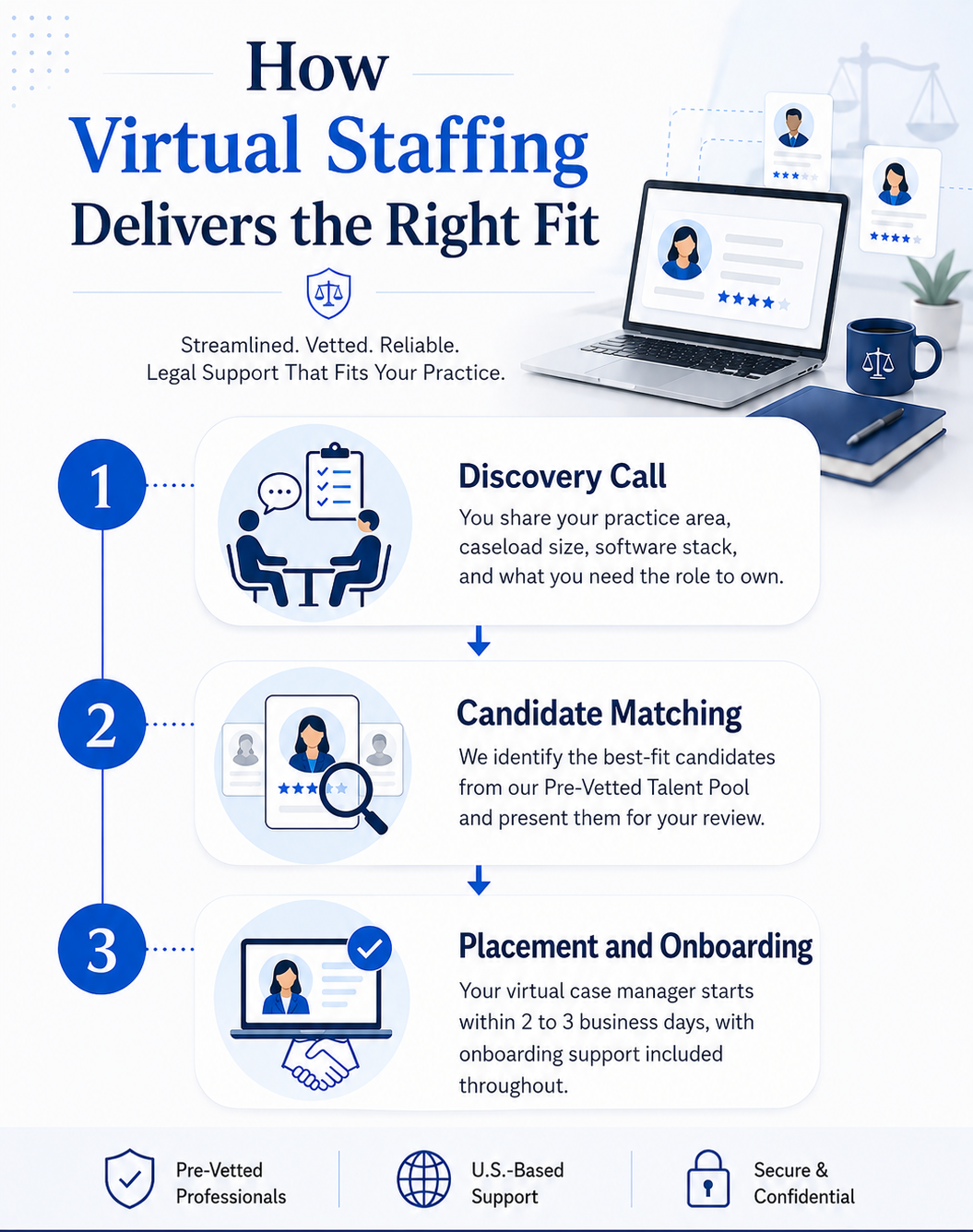
How Virtual Staffing Delivers the Right Fit
Virtual Staffing places trained, U.S. Law Experienced virtual case managers with law firms across the country. Our Pre-Vetted Talent Pool draws from over 300,000 screened candidates globally, and only the top 1% are placed.
The placement process has three steps:
- Discovery call. You share your practice area, caseload size, software stack, and what you need the role to own.
- Candidate matching. We identify the best-fit candidates from our Pre-Vetted Talent Pool and present them for your review.
- Placement and onboarding. Your virtual case manager starts within 2 to 3 business days, with onboarding support included throughout.
Every placement includes:
- Dedicated assistant model where one case manager works exclusively with your firm
- Flat-rate pricing with no hourly fluctuations or hidden fees
- Trained professionals with verified U.S. legal workflow experience
- Bilingual English and Spanish support available at no added cost
- Replacement guarantee if the fit is not right
Your Firm Has the Caseload. Now Build the Capacity to Match It.
The firms that grow are not the ones with the most attorneys. They are the ones with the operational infrastructure to handle more cases without burning out the team they already have.
A Trained virtual case manager from Virtual Staffing gives your firm that infrastructure. Attorneys recover billable hours. Clients stay informed. Cases move faster. Overhead drops. And your firm is in a position to take on more work without the strain that usually comes with it.
Placement takes 2 to 3 business days. Flat-rate pricing. No surprises.
Book a Free Placement Call with Virtual Staffing
Frequently Asked Questions
How does a virtual case manager improve law firm profitability?
When coordination tasks move off an attorney's plate, the billable hours that were quietly disappearing into non-legal work come back. The Clio 2024 Legal Trends Report found attorneys average just 2.9 billable hours per workday. Delegating case coordination directly increases that number without extending the workday or raising overhead costs.
Can a virtual case manager improve client satisfaction at my firm?
Yes, and this is one of the most consistent things firms report after making the hire. A dedicated virtual case manager keeps clients updated on a schedule, responds to inquiries promptly, and handles the communication touchpoints that clients use to judge their experience. Proactive, consistent contact reduces complaints, improves reviews, and brings in more referrals.
What types of law firms benefit most from virtual case managers?
High-volume practice areas see the strongest return, including personal injury, workers' compensation, immigration, family law, Social Security disability, and mass tort. Solo and small firm attorneys benefit the most immediately because they have often been doing all the coordination themselves. Mid-sized firms benefit by freeing experienced staff to focus on higher-value legal work.
How quickly can a virtual case manager from Virtual Staffing start?
Placement typically takes 2 to 3 business days. Every candidate in the Pre-Vetted Talent Pool is pre-screened for legal workflow knowledge and software fluency before they are presented to a firm, so there is no extended ramp-up period before your new case manager becomes genuinely productive.