


Virtual legal assistant services have become a practical solution for law firms dealing with administrative workload and overhead costs. These services give firms access to trained legal support staff without the cost of hiring a full-time in-house employee.
With many options available, finding the right service for your law firm can be challenging. Based on our experience in virtual staffing, we reviewed and tested different providers using specific criteria to identify the best overall options and the best fit for different types of law firms.
This guide covers six of the best virtual legal assistant services available in 2026, how they work, what they cost, and how to choose the right one for your firm.
What Are Virtual Legal Assistant Services?
Virtual legal assistant services connect law firms with remote legal professionals who handle administrative and legal support tasks. These assistants work off-site, usually through a staffing agency, outsourcing provider, or independent contractor arrangement, and support the firm using secure communication tools and practice management platforms.
The range of tasks they can cover is broad and depends on what the law firm assigns to them. Since they work like legal assistants, just remotely, firms can often expect them to handle many of the same tasks as in-house staff. Common responsibilities include client intake, calendar management, document drafting, legal research, billing support, and correspondence.
6 Best Virtual Legal Assistant Services: Quick Comparison
Top 6 Best Virtual Legal Assistant Services
1. Legal Soft
Legal Soft specializes in placing full-time virtual legal assistants with law firms across the U.S. It was built exclusively for the legal industry, with staff trained by U.S.-based attorneys across major practice areas. It’s also known for fast onboarding, with firms typically able to start working with their assistant within 3 business days.
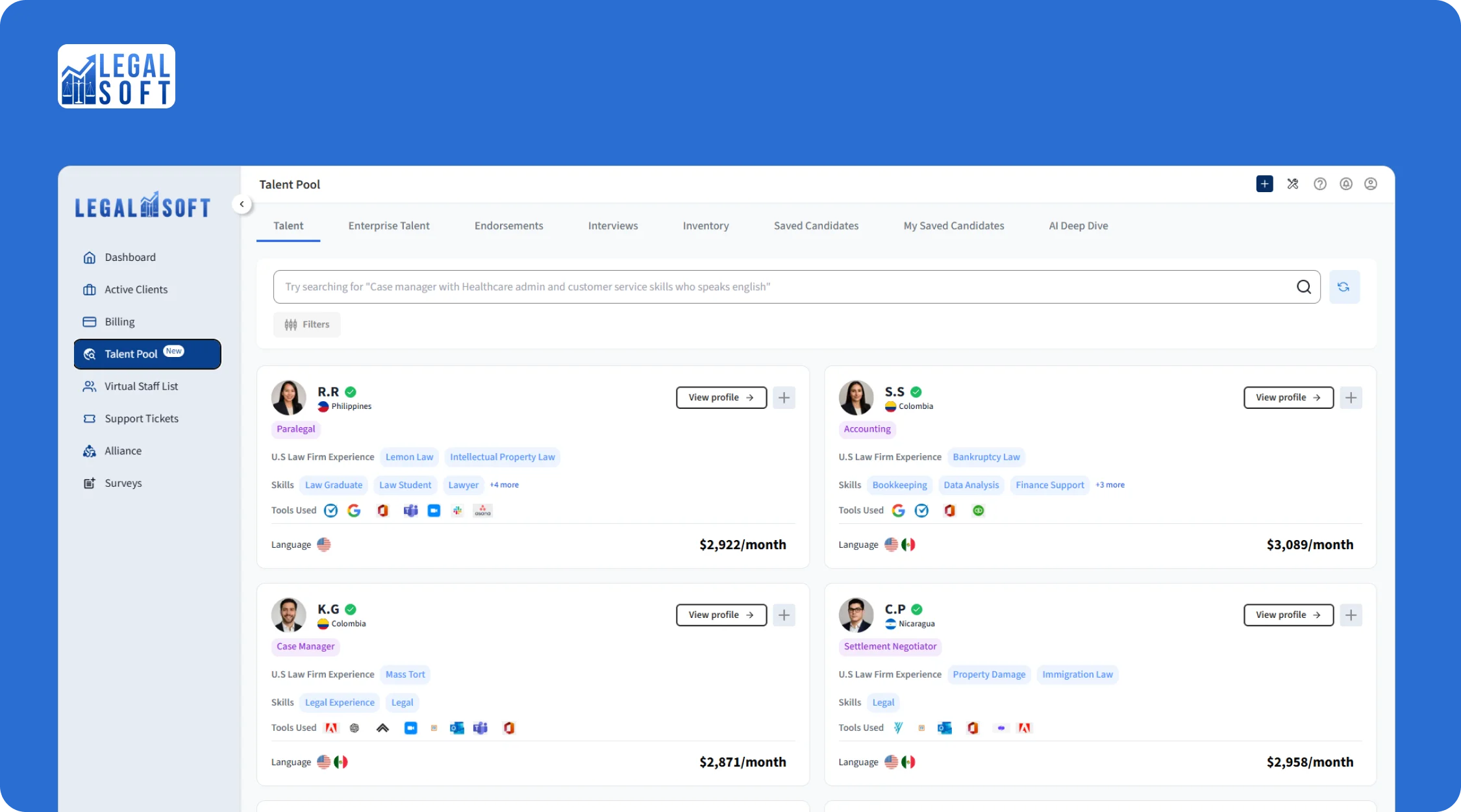
Services: Legal Soft offers a wide range of legal support roles, including legal assistants, paralegals, intake specialists, and attorneys. Services are available on a monthly basis with no long-term contracts.
Staffing model: Legal Soft vets, recruits, and trains assistants who join their talent pool on the platform. Law firms browse and select directly, then work with their chosen assistant on a full-time, exclusive basis. The firm handles day-to-day direction while Legal Soft covers HR, payroll, and compliance.
2. Virtual Staffing
Virtual Staffing connects law firms with pre-screened, legally trained remote assistants. The company focuses on fast placement and matching firms with candidates who already have experience working with U.S. law firms.
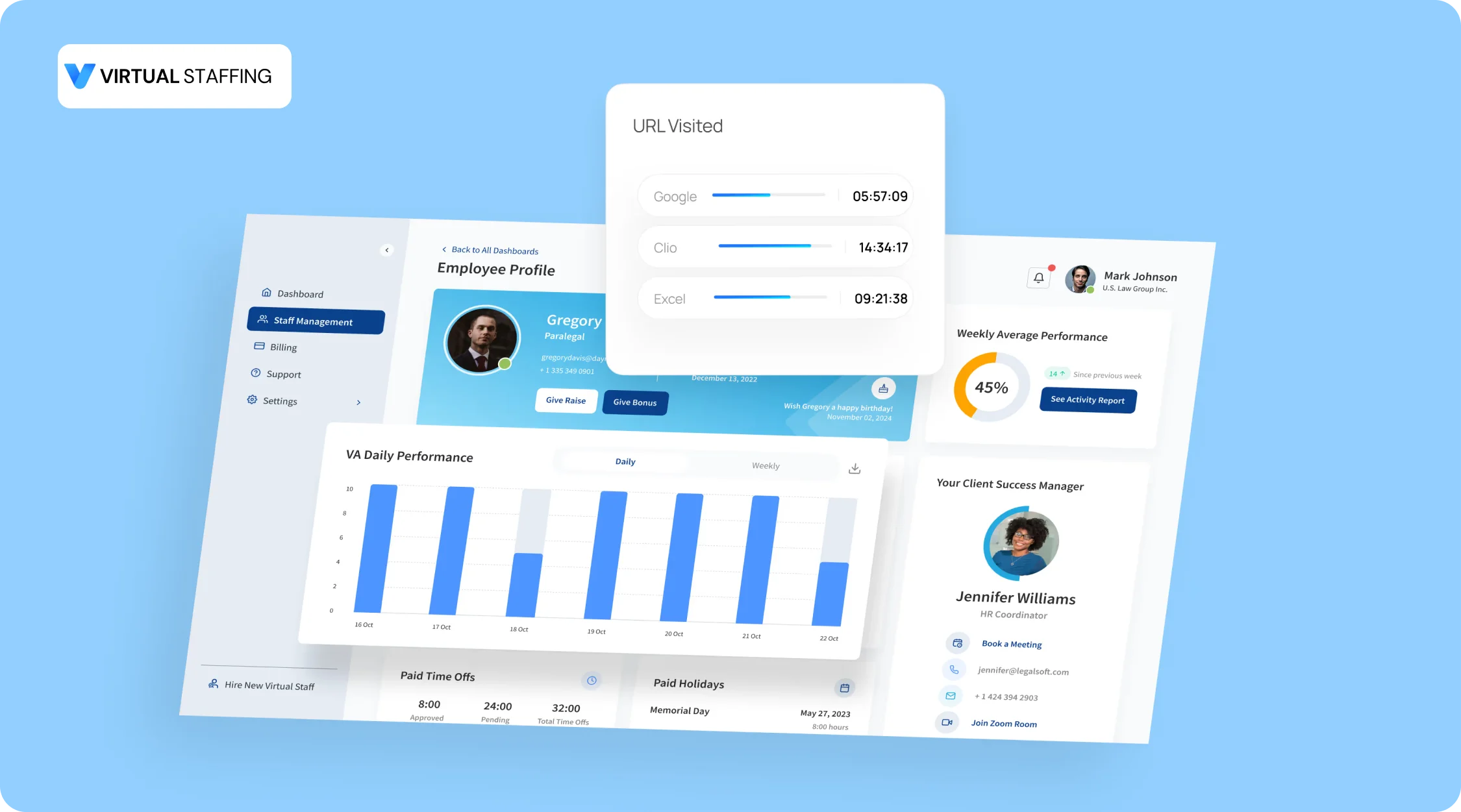
Services: Assistants placed through Virtual Staffing can handle document preparation, client communication, case research, intake, and administrative support across multiple practice areas.
Staffing model: Your assigned assistant works exclusively for your firm on a full-time basis under your direct supervision and daily direction. Virtual Staffing takes care of sourcing, vetting, and onboarding.
3. Equivity
Equivity provides virtual assistant services across different industries, including support for professionals who have experience in legal or executive assistant roles. It’s known for flexible, hour-based packages that don’t require long-term commitments.
Services: Legal clients use Equivity for scheduling, client communication, document formatting, research support, and general administrative work. Assistants can also support legal billing and time entry.
Staffing model: Clients work with a dedicated assistant who is employed by Equivity. The firm purchases monthly hour bundles, and the assistant works based on the number of hours included in the selected plan.
4. Lawfecta
Lawfecta offers a legal talent directory and marketplace for law firms and freelancers. The company serves firms that need project-based support or more than basic administrative help.
Services: Lawfecta assistants offer paralegal-level support and commonly handle document drafting, discovery support, billing review, and client intake.
Staffing model: Lawfecta uses a marketplace model where firms can connect with vetted freelance legal professionals, post gigs, review pitches, and hire based on their needs.
5. Zirtual
Zirtual offers U.S.-based virtual assistants for legal practices. It's a practical option for firms that prefer working with domestic staff for time-zone alignment and communication consistency.
Services: Zirtual offers several types of virtual assistant services. Under its legal assistant plan, attorneys can get support with tasks like scheduling, research, client follow-up, document organization, and general administrative work.
Staffing model: Clients are matched with a dedicated U.S.-based assistant who works a set number of hours per month based on the plan the firm selects. Zirtual handles employment and management of the assistant on the back end.
6. Regents
Regents works across several industries and places college-educated talent as virtual assistants, including legal support roles for law firms. It focuses on matching firms with assistants who have experience supporting litigation work.
Services: Regents places legal assistants, intake specialists, case managers, medical records specialists, and medical records clerks. Since many of its assistants are based in Mexico, firms can also access bilingual support in English and Spanish.
Staffing model: Regents operates as a staffing agency, sourcing and vetting candidates then presenting them to the client firm for selection.
Pros and Cons of Virtual Legal Assistant Services
Before committing to a virtual legal assistant service, it’s helpful to weigh the advantages and limitations. Here’s what to expect:
Pros
- Lower overhead: Firms can avoid many costs tied to in-office staff, including benefits, equipment, and office space.
- Faster hiring: Most providers already have a talent pool and can place an assistant within days, compared to weeks or months for traditional hiring.
- Legal-trained staff: Providers often pre-train assistants in specific practice areas and legal software, reducing the time firms spend on onboarding.
- Flexible arrangements: Many services offer month-to-month or hour-based plans, giving firms the ability to adjust support levels as caseloads shift.
- Access to specialized skills: Some services offer roles with experience in specific practice areas, which can be difficult to recruit locally.
Cons
- Variable quality: Assistant skill levels differ between providers and even within the same company, so vetting and trial periods matter.
- Potential data security risks: Remote work introduces data security considerations, so firms need clear agreements, secure tools, and proper access controls.
- Less direct oversight: Managing someone remotely requires more deliberate communication and structured workflows than in-person supervision.
What to Look for in Virtual Legal Assistant Services
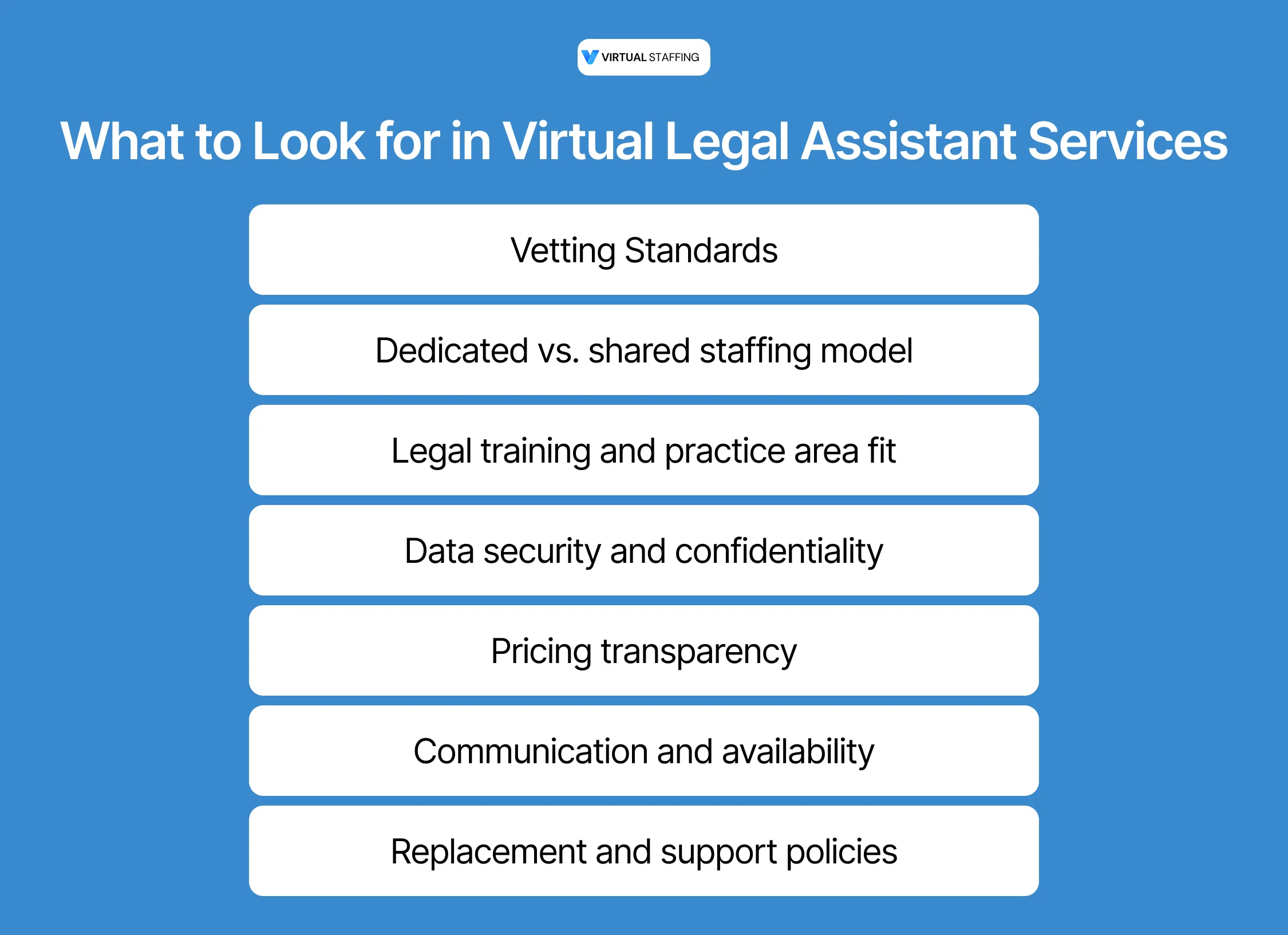
Choosing the right service is about finding a partner that can work as a true extension of your firm and support your daily workflow. The goal is to increase your capacity by delegating tasks confidently, not to add another layer to manage.
Here’s a closer look at the factors that matter most when evaluating your options.
Vetting Standards
Ask how providers screen their candidates. Background checks, skills assessments, and prior legal experience should be baseline expectations.
Dedicated vs. shared staffing model
Dedicated assistants work exclusively for your firm, which typically means faster ramp-up and better familiarity with your clients and processes. Shared models may cost less, but availability can be less consistent. Know which model you're paying for before signing.
Legal training and practice area fit
Check whether the provider trains assistants specifically for legal work and whether they match assistants to your practice area. A firm handling immigration cases has different needs than one focused on commercial litigation. Ask providers how they assess legal knowledge before placement.
Data security and confidentiality
The assistant may handle client communications, case files, and sensitive documents. Ask providers what security protocols they use, whether staff sign NDAs, and how data is stored and transferred. Firms with strict confidentiality obligations should verify these details before onboarding.
Pricing transparency
Some services charge flat monthly rates, while others bill by the hour or by task. Look for clear pricing structures with no hidden fees for onboarding, replacement, or software access.
Communication and availability
Confirm the assistant’s working hours, time zone, and expected response times. For client-facing tasks like intake and correspondence, availability during business hours is important. Ask whether backup support is available if the primary assistant is unavailable.
Replacement and support policies
Ask what happens if the assigned assistant isn’t a good fit or leaves the role. Providers with strong replacement policies can help find a replacement at no extra cost and with minimal disruption. This also shows how much the provider values long-term relationships over one-time placements.
When to Use Virtual Legal Assistant Services
Virtual legal assistant services make the most sense in the following situations:
- Attorneys spending too much time on non-billable work. If recurring administrative tasks like client intake calls, status updates, or document formatting are taking up attorney time, delegating those to a trained remote assistant frees up hours for billable work.
- Solo and small firms not ready for a full-time hire. Bringing on in-house staff involves salary, benefits, equipment, and long-term commitment. A virtual assistant lets you add capacity without those fixed obligations, which is especially valuable for firms in growth mode.
- Mid-size firms with irregular caseloads. Seasonal spikes, new case types, or intake surges create unpredictable demand. Virtual services let you scale up quickly and pull back when volume drops, rather than carrying overhead you don't need.
- Attorneys experiencing burnout. Bloomberg Law's 2024 Attorney Well-Being Report found that 52% of private practice and in-house lawyers reported burnout due to overwhelming workloads. Offloading administrative work is one of the more concrete steps a firm can take to reduce that pressure.
- Firms growing faster than its capacity. If your firm is growing faster than you can hire in-house, a virtual staffing service can help fill support gaps without forcing you to rush through a full hiring process.
Get the Right Virtual Legal Assistant for Your Law Firm
The right service depends on your practice area, caseload volume, and how much direct management you want to handle. A solo immigration attorney will have different needs than a multi-attorney personal injury firm.
Before you reach out to any provider, make a list of the repetitive tasks that take up too much time but don’t require your expertise or legal judgment. These are usually the easiest tasks to delegate.
However, using a virtual legal assistant service doesn’t mean handing everything over and expecting it to work on its own. You still need to set up clear systems and workflows so your assistant can operate without constant back-and-forth.
At Virtual Staffing, the model is straightforward. You skip the sourcing wait and browse directly from a pool of over 500 vetted candidates who are ready to work full-time for your firm. Their experience working with law firms across practice areas makes them a practical choice for firms at different stages of growth.
Ready to find the right support for your firm? Talk to our practice growth consultant to see which virtual legal assistant best fits your workflow.
Virtual Legal Assistant Services FAQs
What is the best virtual legal assistant service for startup firms?
Legal Soft is a practical option for startup firms because of its 3-day onboarding and support across all practice areas. Startups benefit from getting operational support quickly without building a full in-house team, and Legal Soft’s model lets a new firm delegate administrative tasks immediately.
What is the best virtual legal assistant service for solo attorneys?
Solo attorneys usually benefit most from affordable support that doesn’t require long-term contracts, especially when they need specialized skills without spending time on training. Equivity and Legal Soft are strong options because both allow cancellation at any time and offer assistants who can handle substantive work like legal research and document drafting.
What is the best virtual legal assistant service for small law firms?
Virtual Staffing and Regents both work well for small firms that need dedicated, practice-area-specific support. Both providers focus on matching firms with assistants who have relevant legal experience, reducing the time spent on onboarding.
What types of services do virtual legal assistants do?
Virtual legal assistants typically handle client intake, scheduling, document drafting, court deadline tracking, billing and time entry support, legal research, correspondence, and case management. The specific scope depends on the assistant's training and experience.
How do virtual legal assistants ensure security and confidentiality?
Reputable providers require assistants to sign NDAs and use secure communication tools. Firms should also confirm whether the provider has policies for data storage, access controls, and what happens to client information when the contract ends.
How do virtual legal assistant services work?
A law firm signs a service agreement with a virtual legal assistant provider. The provider matches the firm with a qualified assistant based on practice area, workload, and scheduling needs. The assistant then works directly with the firm's attorneys, either through the provider's infrastructure or the firm's own systems.
Some providers offer dedicated assistants who work exclusively for one firm. Others use a shared model where one assistant supports multiple clients. Pricing is typically based on hours used, a monthly retainer, or a flat fee per service tier.