


Key Takeaways
- Paralegals handle substantive legal work and more complex legal tasks under attorney supervision.
- Legal assistants focus primarily on administrative tasks and workflow coordination.
- A virtual legal assistant or virtual paralegal can provide administrative support or substantive legal support remotely.
- The right legal support depends on your law firm’s needs, growth stage, and operational bottlenecks.
If you’re comparing legal assistant vs paralegal vs virtual assistant, you’re really asking a deeper question: what kind of legal support will improve your law firm’s operations without increasing unnecessary overhead?
These roles overlap, especially in smaller law offices, but they differ in training, scope of legal work, cost structure, and ability to handle complex legal tasks. Understanding those differences is essential for building efficient legal teams in today’s legal industry.
Let’s break it down clearly.
Understanding the Legal Field: Why Titles Matter
Within the legal field, job titles can blur. Many law firms use “legal assistants and paralegals” interchangeably, even though their responsibilities often differ.
The distinction matters because it affects:
- The type of legal tasks delegated
- Billing eligibility
- Required legal education or specialized training
- Salary expectations and office space costs
- Ethical supervision requirements
Choosing the wrong structure can slow down case preparation, disrupt document management, and limit your firm’s ability to scale.

What Is a Paralegal?
According to the American Bar Association, paralegals perform substantive legal tasks under attorney supervision. They cannot practice law or represent clients independently, but they play crucial roles in supporting legal strategy and legal proceedings.
Paralegals typically have formal legal education, often including a paralegal certificate, associate degree, or bachelor’s degree in paralegal studies. Many also belong to professional organizations that promote legal ethics and continuing education.
In a typical legal setting, paralegals:
- Draft complex legal documents
- Conduct legal research using legal databases like Westlaw or LexisNexis
- Assist in case preparation
- Manage discovery and legal processes
- Organize evidence and support legal proceedings
- Apply precise legal terminology in filings
Paralegals and legal assistants both support attorneys, but paralegals handle more substantive legal work and more complex legal tasks that require deeper legal knowledge.
Because their work contributes directly to case outcomes, it is often billable when properly supervised.
What Is a Legal Assistant?
Now let’s look at the legal assistant vs paralegal distinction more closely.
Legal assistants work primarily on administrative and clerical tasks that keep a law office running smoothly. While they may assist with document preparation and managing case files, their responsibilities typically focus more on workflow coordination than substantive legal support.
Legal assistants focus on:
- Client communication and scheduling
- Organizing case files and document management
- Coordinating filings and legal procedures
- Managing calendars and deadlines
- Supporting document management systems
- Handling administrative duties and clerical tasks
In many firms, legal assistants work closely with paralegals and attorneys to ensure legal operations stay organized. They are essential to a law firm’s operations, especially in fast-paced legal practices.
While they may assist in drafting legal documents, they typically do not handle more complex legal tasks that require deeper legal expertise.
What Is a Virtual Legal Assistant?
A virtual assistant in the legal industry works remotely rather than inside your physical law office.
A remote legal assistant may perform administrative support tasks similar to an in-house legal assistant. However, many virtual legal assistants bring specialized training and legal education that allows them to provide more substantive legal support.
There are two main categories:
First, administrative virtual legal assistant services that handle scheduling, digital communication tools, intake coordination, and organizing case files.
Second, legally trained professionals—often called a virtual paralegal—who conduct legal research, assist with drafting legal documents, and manage case management systems.
Most virtual legal assistants are experienced legal professionals familiar with legal software, document management systems, secure communication tools, and digital communication tools used in modern legal teams.
The main difference isn’t capability—it’s location and cost structure.
Also Read: Benefits of Hiring a Virtual Assistant for Lawyers
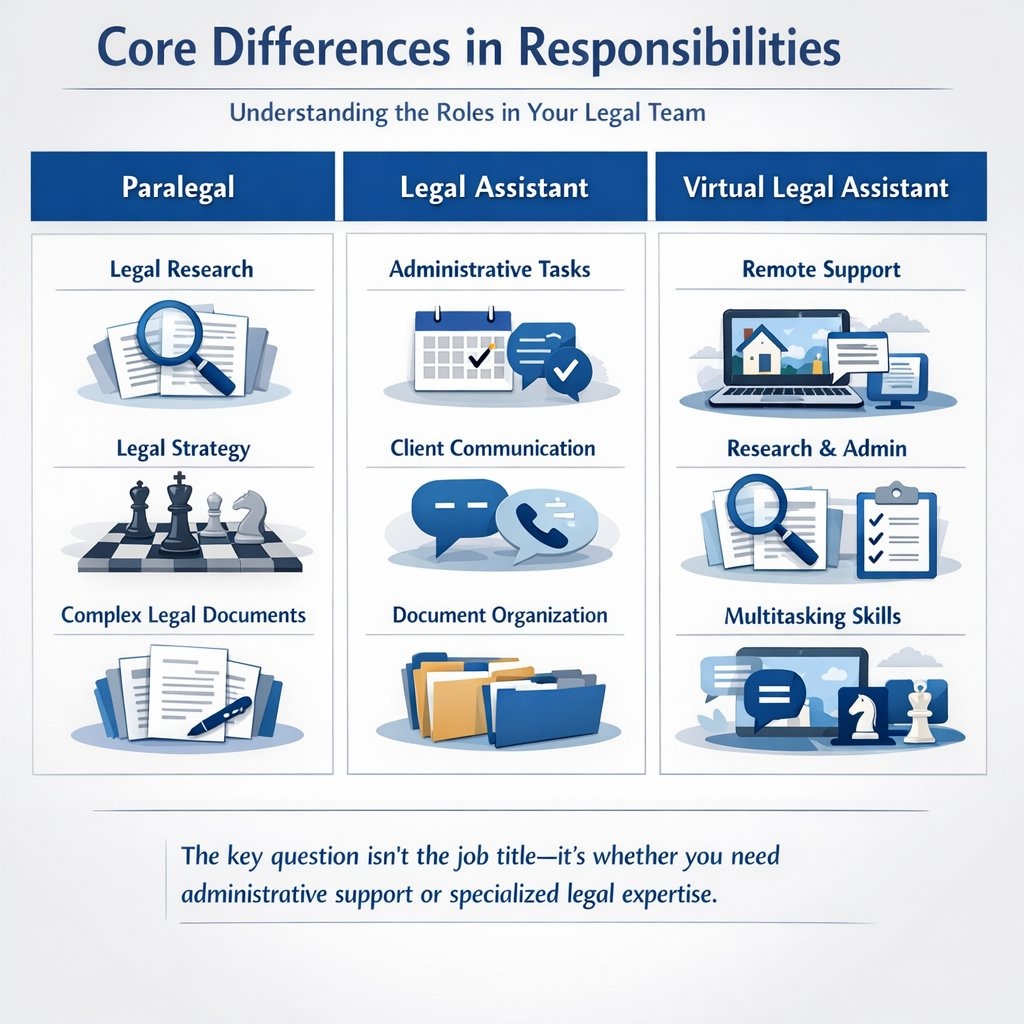
Core Differences in Responsibilities
When comparing legal assistant vs paralegal vs virtual assistant, the real difference lies in the type of legal work performed.
Paralegals conduct legal research, support legal strategy, and assist with complex legal documents. They contribute directly to case preparation and legal proceedings.
Legal assistants focus more on administrative tasks, client communication, and document organization. They ensure legal processes run efficiently but typically avoid more substantive legal work.
A virtual legal assistant can do either, depending on their background. Many virtual legal assistants provide specialized legal support remotely, while others focus primarily on administrative duties.
The key question isn’t the job title—it’s whether you need administrative support or specialized legal expertise.
Cost Structure: In-House vs Remote Legal Assistant
Hiring in-house legal professionals means covering salary, benefits, payroll taxes, legal software licenses, and office space.
A traditional law office model increases fixed overhead, especially when hiring both paralegals and legal assistants.
By contrast, a remote legal assistant reduces physical overhead costs and often lowers total employment expenses. Virtual legal assistant services typically eliminate the need for additional office space while maintaining productivity.
For solo attorneys, boutique law firms, and corporate legal departments managing lean budgets, this flexibility can significantly improve margins.
Legal Ethics and Supervision
Whether you hire in-house or remotely, legal ethics remain the same.
Attorneys must supervise legal professionals and ensure compliance with the legal system’s standards. Non-lawyers cannot practice law or represent clients independently.
This means supervising substantive legal tasks, maintaining confidentiality, and using secure communication tools for client communication.
Virtual staffing does not change ethical obligations. It simply changes the structure of delivery.
When Should You Hire a Paralegal?
If your legal practice handles litigation, regulatory matters, or high-volume case preparation, you likely need someone who can handle more substantive legal work.
Paralegals play crucial roles in drafting complex legal documents, conducting legal research, and supporting legal strategy.
They are especially valuable when attorneys are spending too much time on tasks that require legal knowledge but not a law license.
Also Read: Law Clerk vs Paralegal: What Are the Differences?
When Is a Legal Assistant the Right Fit?
If your bottleneck is administrative and clerical tasks rather than complex legal tasks, a legal assistant is likely the better choice.
Missed deadlines, inconsistent client communication, disorganized document management, and inefficient case management systems are operational issues.
Legal assistants work to stabilize those systems and ensure legal procedures stay on track.
For many law firms, the right legal support makes the difference between chaos and consistency.
When Does a Virtual Legal Assistant Make Sense?
A virtual legal assistant becomes strategically valuable when flexibility and scalability matter.
If your law firm’s needs fluctuate, hiring full-time in-house staff may increase risk. Virtual legal assistant services allow firms to scale legal support without long-term fixed payroll commitments.
Many virtual legal assistants bring cross-practice experience from supporting multiple law firms, corporate legal departments, and legal teams. That exposure often strengthens adaptability
and familiarity with legal trends, legal software, and document management systems.
If your firm is expanding or modernizing its legal operations, remote support can provide specialized legal expertise without expanding physical infrastructure.
The Hybrid Model in Modern Legal Practice
Increasingly, law firms combine in-house paralegals with remote legal assistants.
For example, a firm may rely on a senior paralegal for complex legal documents and substantive legal tasks while delegating administrative support and document preparation to a remote legal assistant.
This hybrid structure improves efficiency while protecting margins.
As the legal industry evolves, flexible staffing is becoming part of broader legal trends focused on operational optimization.
Final Thoughts: Choosing the Right Legal Support
The conversation around legal assistant vs paralegal vs virtual assistant is really about alignment.
What does your legal practice truly need?
If you need specialized legal expertise for complex legal tasks, a paralegal may be the right choice.
If your primary issue is managing case files, organizing case files, client communication, and administrative duties, a legal assistant can transform your workflow.
If you need scalable, cost-efficient support that integrates with legal software and digital communication tools, a virtual legal assistant or virtual paralegal may provide the flexibility your law firm’s operations require.
The smartest firms don’t focus on titles. They focus on building legal teams that support legal strategy, protect legal ethics, and strengthen long-term profitability.
The right legal support makes your attorneys more productive, your clients more satisfied, and your legal operations more resilient.
If your goal is to build a stronger, more profitable law firm, the right support structure is not optional—it is strategic.
Explore how Virtual Staffing can help you design a leaner, smarter legal team built for long-term growth.
Book a consultation today and build a smarter legal support system.
Frequently Asked Questions
Is a paralegal higher than a legal assistant?
In many firms, yes. Paralegals typically handle more substantive legal work and may generate billable hours, while legal assistants focus more on administrative coordination.
Can a virtual assistant perform paralegal duties?
Yes, if the virtual assistant has appropriate training and works under attorney supervision. Ethical and billing standards remain the same regardless of work location.
Are paralegals more expensive than legal assistants?
Generally, yes. Paralegals command higher salaries due to specialized legal education and their ability to perform billable substantive work.
Is hiring a virtual paralegal ethical?
Yes. As long as attorneys maintain supervision, protect client confidentiality, and comply with ABA Model Rules, remote legal staffing is permissible.