


Key Takeaways
- Outsourcing legal work to a virtual assistant is ethical under ABA guidelines when you maintain proper supervision, protect client confidentiality, and disclose appropriately.
- ABA Formal Opinion 08-451 explicitly permits lawyers to delegate both legal and nonlegal support tasks to outsourced nonlawyers.
- You can outsource legal research, document drafting, client intake, scheduling, and case management support. Nothing that constitutes the practice of law is delegatable.
- ABA Model Rule 5.3 requires the same level of oversight for a remote virtual assistant as for an in-house paralegal.
- Choosing a Legal-Trained, Pre-Vetted virtual assistant provider means confidentiality agreements, compliance training, and secure data protocols are already built in.
Yes. Outsourcing legal work to a virtual assistant is ethical under ABA guidelines when you maintain supervision, protect client confidentiality, and disclose appropriately.
The concern is understandable. Legal work involves sensitive client data, strict bar obligations, and professional accountability. But this is not an open question. Bar associations already settled it. The real issue is not whether you can outsource. It is whether you do it correctly.
This guide breaks down exactly what the rules require, which tasks you can and cannot delegate, how supervision works in practice, and what to look for in a virtual legal assistant service that keeps your firm fully compliant.
What the ABA Actually Says About Outsourcing Legal Work
The American Bar Association addressed this directly in 2008, and the answer was not a prohibition. It was a framework.
ABA Formal Opinion 08-451 confirmed that lawyers may outsource both legal and nonlegal support services to vendors, independent contractors, and nonlawyers outside the firm. The opinion covers everything from document review and legal research to administrative support, including work sent to offshore providers.
The conditions are straightforward:
- Maintain adequate supervision over anyone performing outsourced work
- Protect client confidentiality throughout the engagement
- Avoid conflicts of interest with the outsourced provider
- Charge only reasonable fees, without an unreasonable markup on outsourced services
- Prevent the unauthorized practice of law by ensuring nonlawyers do not perform tasks reserved for licensed attorneys
The ABA's position has not changed since that opinion. What has changed is the scale at which law firms now use remote legal support, and the quality of the providers available to them.
The Four ABA Model Rules That Govern This Practice
Four specific rules shape every ethical outsourcing arrangement. Understanding each one is the clearest path to building a compliant setup.
Rule 1.1: Competence
This rule requires you to deliver competent representation. When you delegate work to a virtual assistant, you remain responsible for the quality of that work. Delegating a task does not transfer your professional duty. Every work product must go through your review before it is sent out or filed under your name.
Rule 1.6: Confidentiality
Your confidentiality obligations extend to everyone who touches client information, including outsourced support staff. Before sharing any client data with a virtual assistant, confirm that confidentiality agreements are in place and that secure communication channels are being used.
Rule 5.3: Supervision of Nonlawyer Assistance
A 2012 amendment to Rule 5.3 extended its reach to independent contractors and outsourced providers, not just in-house employees. This means your supervision obligations for a remote virtual assistant are identical to those for a paralegal sitting in your office. The standard is "reasonable efforts," which means real oversight (not micromanagement, but meaningful review).
Rule 5.5: Unauthorized Practice of Law
Nonlawyers cannot practice law. A virtual assistant can perform legal research, draft documents, manage client intake, organize case files, and handle administrative workflows. They cannot give legal advice, make legal judgments, or sign anything that requires an attorney's independent professional opinion. Keeping that boundary clear is your responsibility as the supervising attorney.

Tasks You Can and Cannot Outsource to a Virtual Assistant
One of the most practical questions attorneys ask is not whether outsourcing is allowed, but specifically what can be handed off. The answer depends on whether the task requires a law license to perform.
Tasks That Can Be Outsourced
These are fully delegatable to a supervised, Legal-Trained virtual assistant:
- Client intake and screening: collecting initial case information, qualifying leads, and scheduling consultations with attorneys
- Legal research and case summaries: compiling relevant statutes, case law, and regulatory materials for attorney review
- Document drafting and preparation: first drafts of contracts, pleadings, correspondence, and discovery materials
- Case management support: organizing files, tracking deadlines, updating case management software
- Administrative operations: scheduling, billing support, CRM management, and email handling
- Court filing preparation: assembling documents for attorney review before submission
Tasks That Cannot Be Outsourced to Nonlawyers
- Providing legal advice or opinions to clients
- Making independent legal strategy decisions on a matter
- Signing documents in an attorney's professional capacity
- Representing clients in any proceeding
- Exercising independent legal judgment on case outcomes
The line between drafting a document and giving legal advice is one you define and enforce through supervision. A virtual assistant prepares the draft. You determine whether it is legally sound.
How to Supervise a Remote Virtual Assistant Ethically
Supervision is not about checking in every hour. It is about building a workflow where your review and approval are required at every meaningful step.
The ABA's standard is "reasonable efforts." In practice, that means:
- Setting clear task instructions and quality standards upfront, in writing
- Reviewing all work product before it is sent to clients or submitted to a court
- Providing regular feedback when corrections are needed
- Keeping a communication log documenting what was delegated and what was reviewed
- Using shared systems, including your case management platform, so work is visible and auditable at every stage
Geographic distance does not reduce your obligations. Time zone overlap helps significantly: when your virtual assistant works during your business hours, you can answer questions in real time and catch issues before they become problems.
Attorneys using remote intake specialists consistently report that supervision becomes easier, not harder, once a reliable workflow is established. The key is building that structure from day one, not retrofitting it after problems arise.
Confidentiality, Data Security, and Attorney-Client Privilege
Attorney-client privilege does not disappear when a third party handles client information. But protecting it requires deliberate action on your part.
What Confidentiality Protocols Should Be in Place
Every compliant legal outsourcing arrangement includes the following:
- Confidentiality agreements: every virtual assistant handling client data must sign a binding NDA before beginning any work. Verify this before sharing any case information.
- Role-based access controls: give your virtual assistant access only to the systems and files their role requires. Blanket access to your entire client database creates unnecessary risk.
- Encrypted communication: client information should never travel via unsecured email or personal messaging apps. Use encrypted platforms for all file sharing and communication.
- Secure case management software: your virtual assistant should work inside your existing platform. Clio, MyCase, Filevine, and Smokeball are designed with attorney security requirements in mind.
- Incident response protocols: establish in advance what happens if a breach occurs, including your notification obligations under applicable law.
What Happens to Attorney-Client Privilege
Sharing information with a necessary third party who is bound by confidentiality agreements and operating under attorney supervision does not waive attorney-client privilege. The attorney remains responsible for ensuring those protections are actually in place, not just assumed to be.
Law firm data breaches are not hypothetical. According to the 2026 Law Firm Data Security Guide from Clio, security incidents continue to rise across firms of all sizes. A provider that cannot give specific answers about their data security protocols is not a provider you should trust with client information.
When and How to Disclose Outsourcing to Clients
Disclosure requirements depend on what type of work is being outsourced and where you practice. The safest approach is also the simplest: tell clients upfront in your engagement letter.
When Disclosure Is Required
For administrative tasks (scheduling, billing, CRM management), disclosure is generally not required. These are operational functions, not legal work product.
For substantive legal work performed by outsourced nonlawyers (research, document drafting, intake), the ABA recommends obtaining informed client consent. Your engagement letter is the right vehicle for this.
State-specific rules vary:
- Florida explicitly requires disclosure when legal work is outsourced internationally (Florida Bar Ethics Opinion 07-2 and the more recent Opinion 24-1)
- Some states require disclosure whenever outsourced providers receive confidential client information, regardless of geography
- Check your state bar's current ethics opinions before finalizing your disclosure language
How to Draft Disclosure Language
A brief, clear statement in your engagement letter is sufficient in most jurisdictions. Something like: "Our firm may use trained legal support staff for certain tasks, including research, document preparation, and client intake. All support staff are bound by confidentiality agreements and work under direct attorney supervision."
Proactive disclosure protects you and builds client trust. Most clients do not object to firms using trained support professionals. They object to surprises.
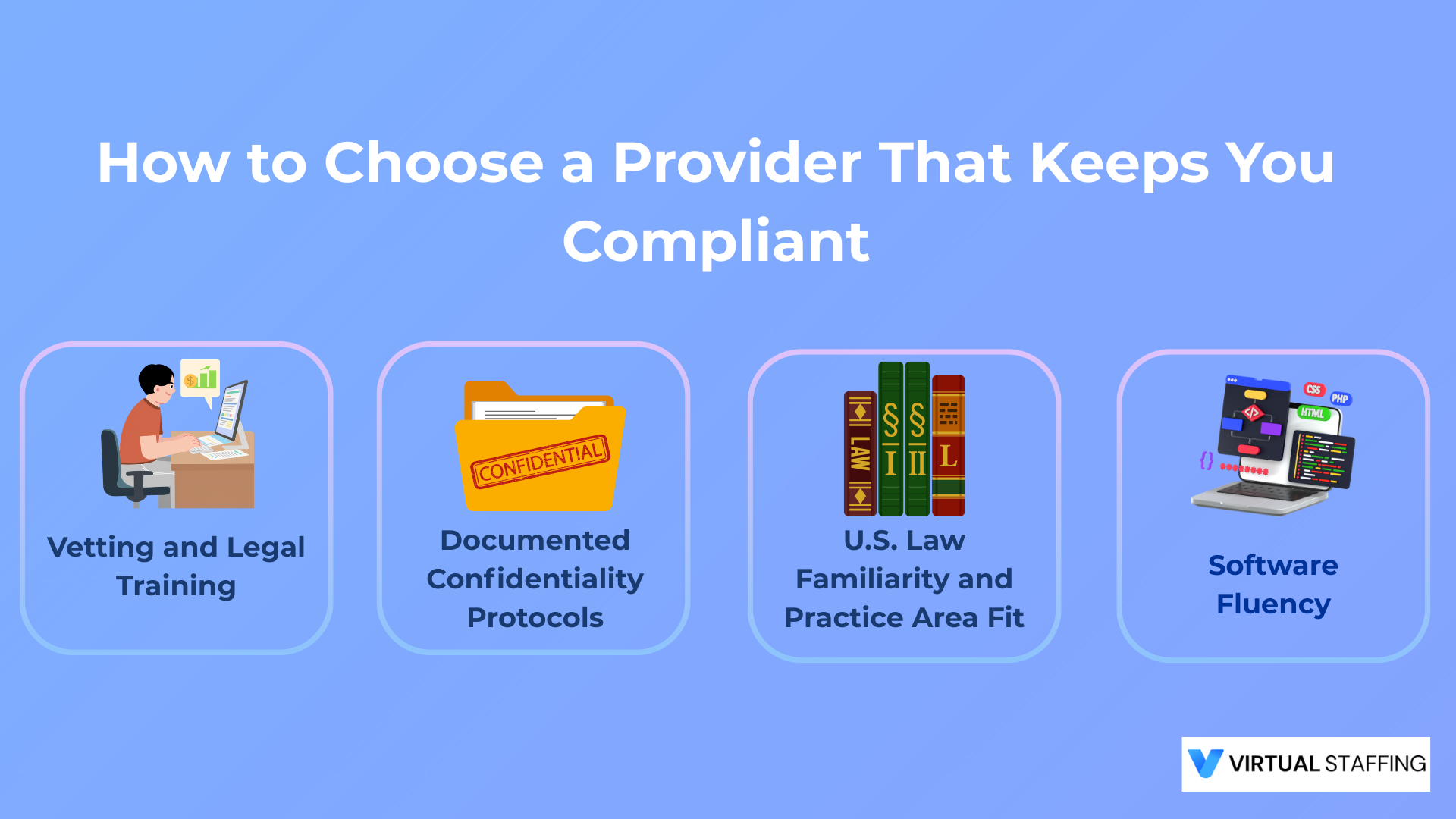
How to Choose a Provider That Keeps You Compliant
Not every virtual assistant provider is equipped to support a law firm's ethical obligations. Here is what separates compliant providers from risky ones.
Vetting and Legal Training
Your virtual assistant should have legal-specific training, not generic administrative experience. Look for providers whose candidates understand legal terminology, attorney-client privilege, ABA compliance standards, and the scope of tasks nonlawyers can and cannot perform.
Documented Confidentiality Protocols
Ask directly: what confidentiality agreements do your virtual assistants sign? What data security standards are in place? How is access to client files controlled? A compliant provider answers these questions with specifics. "We take security seriously" without detail is a red flag.
U.S. Law Familiarity and Practice Area Fit
A virtual assistant who is U.S. Law Experienced, with direct knowledge of American legal workflows, court systems, and practice area terminology, reduces your supervision burden significantly. Providers without this focus may not meet the standard your clients and your bar require.
Software Fluency
Your virtual assistant should integrate with the tools your firm already uses. Clio, MyCase, Filevine, Smokeball, Rocket Matter. Proficiency in your practice management platforms means your oversight workflow stays intact without rebuilding your systems from scratch.
Virtual Staffing's Pre-Vetted Talent Pool is trained exclusively for law firms, HIPAA compliant, and proficient in the case management platforms U.S. attorneys rely on. Every candidate signs confidentiality agreements before placement. Specialists work inside your existing systems from day one.
Explore Virtual Staffing's full service roster to see every role available for law firms of every size from virtual paralegals and legal assistants to intake specialists and case managers.
Turn Compliance Into a Competitive Advantage
Outsourcing legal work to a virtual assistant is ethical. The bar associations confirmed it. The rules are clear. The conditions are manageable.
Most attorneys who hesitate are not worried about the rules themselves. They are worried about doing it wrong. That concern is valid because doing it wrong does create professional risk.
The answer is not to avoid outsourcing. It is to work with a provider built specifically for legal compliance.
Virtual Staffing connects law firms with Legal-Trained, U.S. Law Experienced virtual assistants from a Pre-Vetted Talent Pool. Every specialist signs confidentiality agreements before placement, works inside your existing case management systems, and is trained to operate within the ethical boundaries the ABA requires for nonlawyer supervision.
Your competitors are already delegating intake, research, and case management to trained remote professionals. The question is whether you are set up to do the same, compliantly.
Talk to the Virtual Staffing team and find your first compliant virtual assistant within 24 hours.

Frequently Asked Questions (FAQs):
Can an attorney legally delegate legal work to a virtual assistant?
Yes. ABA Formal Opinion 08-451 confirms that attorneys may delegate both legal and nonlegal support tasks to outsourced nonlawyers, provided the attorney maintains adequate supervision, protects confidentiality, and avoids enabling the unauthorized practice of law.
What tasks can a virtual assistant not perform for a law firm?
A virtual assistant cannot give legal advice, make independent legal judgments, sign documents in an attorney's capacity, or represent clients in any proceeding. Any task that requires a law license stays with the licensed attorney.
Does outsourcing legal work require client consent?
For substantive legal work performed by outsourced nonlawyers, informed client consent is the ABA's recommended standard. For purely administrative tasks, consent is generally not required. State rules vary, so check your state bar's current ethics opinions before finalizing your engagement letter language.
How does ABA Model Rule 5.3 apply to virtual assistants?
Rule 5.3 requires attorneys to make reasonable efforts to supervise nonlawyer assistants, regardless of whether they work onsite or remotely. A 2012 amendment extended this requirement to independent contractors and outsourced providers. The geographic distance of a virtual assistant does not reduce your supervision obligations.
Is attorney-client privilege protected when a virtual assistant handles client information?
Yes, if proper protocols are in place. Privilege is not waived by sharing information with necessary third parties who are bound by confidentiality agreements and operating under attorney supervision. The attorney is responsible for ensuring those protections actually exist.
What should I look for in a legal virtual assistant provider?
Look for legal-specific training, documented confidentiality agreements, specific data security protocols, U.S. legal workflow familiarity, and proficiency in legal practice management software. A reputable provider answers security questions with specifics, not generalities.