

A legal secretary is an administrative professional who supports attorneys in a law firm or legal department. They prepare and format legal documents, manage calendars and court deadlines, handle client communication, and keep case files organized.
The role sits at the center of a law office’s daily operations. This guide covers a legal secretary’s core duties, a typical day, how duties change by practice area, and the skills the job requires. It ends with a sample job description firms can adapt.
Key Takeaways
- A legal secretary handles the administrative and document work that keeps a law office running.
- Core duties include formatting legal documents, e-filing, managing calendars and deadlines, and handling client communication.
- Legal secretaries support attorneys but cannot give legal advice.
- Most U.S. legal secretary roles do not require a specific degree, though certifications from NALS are available.
- Most duties run through software, so firms can fill the role remotely.
What Is a Legal Secretary?
A legal secretary provides administrative support to attorneys and legal staff. Some firms use the title legal administrative assistant for the same role.
What sets the role apart from a general administrative assistant is legal knowledge. A legal secretary must understand legal terminology, court procedures, and document formats. In a law office, a misformatted pleading or a missed filing deadline carries real consequences.
Legal secretaries and paralegals are often confused. Our breakdown of the differences between a legal secretary and a paralegal explains where the two roles split.
Where Does a Legal Secretary Fit in a Law Firm?
A legal secretary is part of a law firm’s support staff. Support roles are usually split by how much legal work each one handles.
Titles overlap, especially in smaller firms. The BLS groups paralegals and legal assistants into one occupation, and many firms use the titles interchangeably. One person may also cover both legal secretary and legal assistant work. A legal secretary may support one attorney or a group of attorneys, depending on the firm’s size.
What Does a Legal Secretary Do?
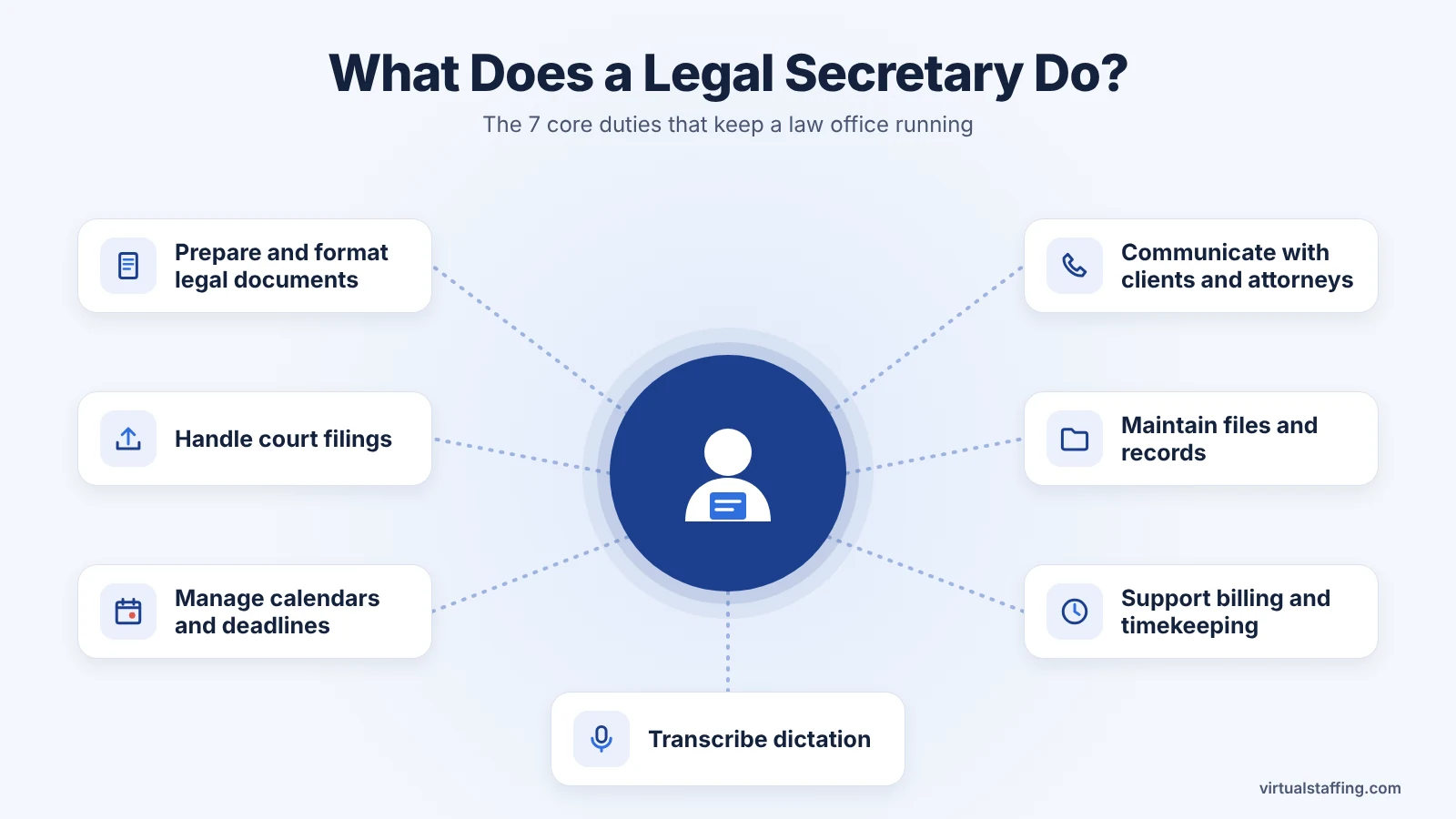
A legal secretary’s duties fall into seven main areas. The exact mix depends on the firm’s size and practice area.
Preparing and Formatting Legal Documents
Legal secretaries prepare correspondence, pleadings, motions, contracts, and other documents from attorney drafts or templates. They format each document to court rules or firm standards and proofread it before attorney review. Many also verify quotes and citations in briefs, a task the U.S. Bureau of Labor Statistics lists as part of the role.
Drafts multiply quickly in a busy office. A clear legal document version control process helps make sure the final version is the one that gets filed or sent.
Handling Court Filings
Legal secretaries file documents with courts, often through electronic filing systems. They confirm each filing was accepted, save the confirmation to the case file, and arrange service on other parties when required.
Managing Calendars and Deadlines
Court dates, filing deadlines, depositions, and client meetings all land on the legal secretary’s calendar. They enter each date as soon as it is known and set reminders so attorneys see deadlines in advance.
A reliable legal calendaring system for court deadlines keeps the whole team working from the same dates.
Communicating With Clients and Attorneys
Legal secretaries answer phones, respond to emails, schedule appointments, and keep clients updated on routine matters. They are often the first point of contact for the firm.
Legal secretaries do not give legal advice. When a client asks what a document means or what to do next, the legal secretary passes the question to the attorney.
Maintaining Files and Records
Legal secretaries open new matters, organize digital and paper files, and keep records current. Many firms run this work inside case management software. Our guide to Clio and MyCase workflows for remote legal staff shows how that looks in practice.
Supporting Billing and Timekeeping
Many legal secretaries help track attorney time, prepare invoices, and follow up on unpaid bills. Some firms hand this work to a dedicated law firm bookkeeper instead.
Transcribing Dictation and Correspondence
Some attorneys still dictate letters, memos, and notes. Legal secretaries transcribe those recordings into finished documents.
A Day in the Life of a Legal Secretary
No two days are identical, but most follow a similar rhythm. Here is what a typical day can look like at a small or mid-size firm.
- Morning: Review the day’s calendar and confirm upcoming deadlines. Check overnight emails and voicemails, then flag anything urgent for the attorney.
- Late morning: Format and proofread documents the attorney drafted the day before. Prepare filings due that week.
- Midday: Submit court filings and save confirmations to the case files. Schedule depositions or client meetings as requests come in.
- Afternoon: Return client calls and send status updates. Open new matters and organize incoming documents.
- End of day: Add any new dates to the calendar. Prepare files and an agenda for the attorney’s next morning.
The pace shifts when a deadline or trial is close. Those stretches can be stressful, with longer hours and faster turnarounds. Strong calendaring habits and clear priorities make them easier to manage.
Legal Secretary Duties by Practice Area
The core work stays the same across firms. What changes is the type of documents and deadlines involved.
In litigation practices, much of this work overlaps with the litigation assistant role. Our guide on what a litigation assistant does covers that role in detail.
Skills a Legal Secretary Needs
A legal secretary needs strong organization, working legal knowledge, and solid technical skills.
- Organization and attention to detail: one wrong date or typo can cause real problems in a legal matter.
- Legal terminology and procedures: legal secretaries need to understand the documents they prepare and the rules for filing them.
- Typing and proofreading: fast, accurate typing and careful proofreading are daily requirements.
- Legal software: most firms expect experience with case management software, such as Clio or MyCase, and Microsoft Word. Federal court filings also require familiarity with the CM/ECF e-filing system.
- Discretion: legal secretaries handle privileged and confidential information every day.
- Communication: legal secretaries work with attorneys, clients, court clerks, and outside vendors.
Do Legal Secretaries Need a Degree?
Most legal secretary jobs in the U.S. do not require a specific degree. According to the Bureau of Labor Statistics, entry-level secretarial roles typically require a high school diploma. Legal secretaries may also train for several months to learn legal terminology and practices. Some candidates complete a legal secretary or legal studies program first.
Certification is optional but can help candidates stand out. NALS, the Association for Legal Professionals, offers the Accredited Legal Professional (ALP) certification for people entering the field. It also offers the Professional Legal Secretary (PLS) certification, also called Certified Legal Professional (CLP), for experienced professionals.
How Much Does a Legal Secretary Make?
Legal secretaries and administrative assistants earned a median annual wage of $55,570 in May 2025, according to the BLS Occupational Outlook Handbook. That is higher than the $48,310 median for all secretaries and administrative assistants. Pay varies by location, firm size, practice area, and experience.
Are Legal Secretaries in Demand?
The BLS counted about 157,600 legal secretary and administrative assistant jobs in 2025. It projects employment in the role to decline 5% from 2025 to 2035. The BLS links the decline to technology that lets more staff prepare their own documents.
Can a Legal Secretary Work Remotely?
Yes, a legal secretary can work remotely. Document preparation, e-filing, calendaring, and client email all run through software. Our guide to hiring a virtual legal secretary covers how remote secretarial support works for law firms.
FAQs About Legal Secretaries
What does a legal secretary do?
A legal secretary supports attorneys with administrative and document work. Their duties include preparing and formatting legal documents, filing with courts, managing calendars and deadlines, communicating with clients, and maintaining case files.
2.What does a legal secretary do day to day?
A typical day includes reviewing the calendar and deadlines, formatting and proofreading documents, and submitting court filings. Legal secretaries also return client calls and organize case files. The pace picks up when a filing deadline or trial is close.
What is a legal secretary’s job description?
A legal secretary job description usually covers document preparation, court filings, calendar and deadline management, client communication, file management, and billing support. Most roles require law office experience and familiarity with legal software.
Do legal secretaries need a degree?
Most U.S. legal secretary jobs do not require a specific degree. Employers usually look for law office experience and knowledge of legal procedures. Certifications from NALS, such as the ALP, are optional but can strengthen a candidate.
What skills does a legal secretary need?
Key skills include organization, attention to detail, and knowledge of legal terminology. Legal secretaries also need fast, accurate typing, experience with legal software, discretion with confidential information, and clear communication.