

A litigation assistant is a legal support professional who helps attorneys manage lawsuits from filing to resolution. They handle court filings, deadlines, discovery documents, and trial preparation under attorney supervision.
Lawsuits generate paperwork at every turn, and each document carries a deadline. A litigation assistant keeps that flow organized so attorneys can focus on strategy, negotiation, and courtroom work.
This guide explains what a litigation assistant does and which skills the role requires. It also compares the role to a litigation paralegal and shows when your firm should hire one.
Key Takeaways
- A litigation assistant supports attorneys through every stage of a lawsuit, from the first filing to case closing.
- Their work centers on deadlines, court filings, discovery documents, and trial preparation.
- The role is more administrative than a litigation paralegal’s, though the two often overlap.
- Litigation assistants work under attorney supervision and cannot give legal advice or sign pleadings.
- Many firms now fill this role with a remote legal assistant who works inside the firm’s own systems.
What Is a Litigation Assistant?
A litigation assistant is a legal support professional who works on cases headed to court or already in court. They handle the administrative and document side of a lawsuit under an attorney’s direction.
Some firms call the role a litigation legal assistant or a litigation secretary. The title changes from firm to firm. The core job stays the same: keep the case file complete, accurate, and on schedule.
Litigation assistants work across civil practice areas. Personal injury, employment, family law, business disputes, and insurance defense firms all rely on them. Our guide on what a litigation lawyer does and when clients need one covers the attorneys they support.
What Does a Litigation Assistant Do?
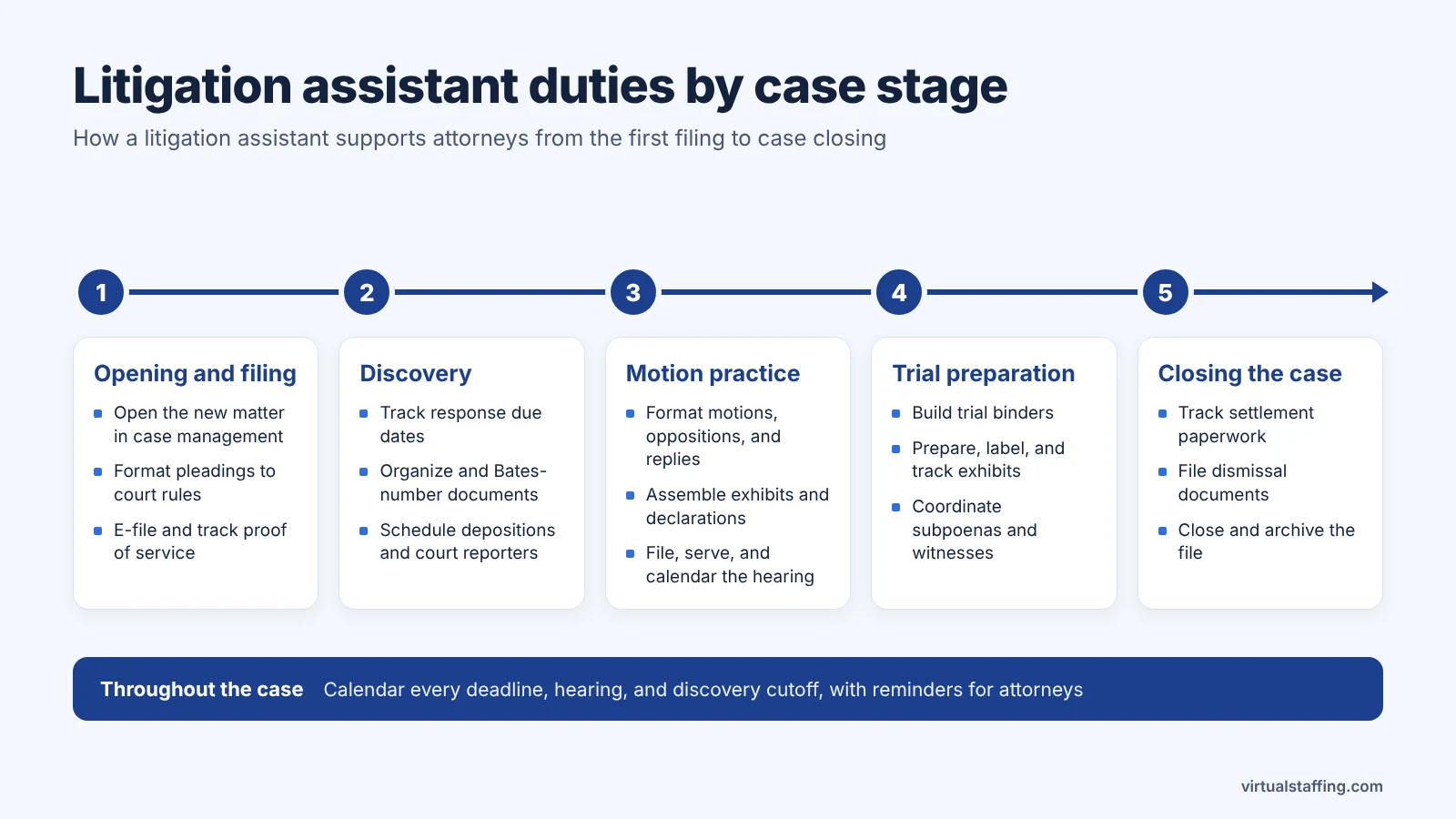
A litigation assistant manages the filings, deadlines, documents, and logistics that move a lawsuit forward. The duties follow the life of a case, from the first filing to closing the file.
Opening the Case and Filing
- Open the new matter in the firm’s case management system
- Gather client documents, records, and correspondence
- Format complaints, answers, and other pleadings to meet court rules
- E-file documents and save filing confirmations to the case file
- Arrange service of process and track proof of service
Managing Deadlines and the Calendar
Court deadlines drive every lawsuit. A missed date can damage a client’s case and expose the firm to risk.
Litigation assistants calendar response dates, hearings, and discovery cutoffs as soon as a document arrives. They also set reminders so attorneys see each date well before it lands.
This work is only as reliable as the system behind it. A clear legal calendaring process for tracking court deadlines keeps the whole team working from the same dates.
Supporting Discovery
Discovery often produces the largest volume of documents in a case. Litigation assistants help by:
- Preparing interrogatories, requests for production, and requests for admission from attorney templates
- Tracking when discovery responses are due from each party
- Organizing produced documents and applying Bates numbers
- Building document indexes and draft privilege logs for attorney review
- Scheduling depositions, court reporters, and video links
In personal injury cases, discovery usually includes medical records and bills. Some firms split this work by handing records requests to a dedicated legal document collector.
Handling Motion Practice
- Format motions, oppositions, and replies
- Assemble exhibits and supporting declarations
- Check tables of contents, page limits, and formatting
- File and serve motion papers, then calendar the hearing
Preparing for Trial
The workload peaks as trial approaches. Litigation assistants:
- Build trial binders for attorneys and witnesses
- Prepare, label, and track exhibits
- Draft exhibit lists and witness lists for attorney review
- Coordinate subpoenas and witness schedules
- Handle logistics for the trial team
Closing the Case
Many cases settle before trial. When they do, the litigation assistant tracks settlement paperwork and dismissal filings. They then close and archive the file according to firm policy.
Skills a Litigation Assistant Needs
A litigation assistant needs strong organization, working knowledge of court rules, and comfort with legal software. A typical litigation assistant job description lists these skills.
Organization and attention to detail. One wrong date or missing exhibit can cause real problems in court.
Knowledge of court rules. Each court has its own formatting, filing, and service requirements.
E-filing experience. Many state and federal courts require electronic filing for attorneys.
Case management software. Firms commonly run cases in tools like Clio and MyCase. Our walkthrough of Clio and MyCase workflows for remote legal staff shows how assistants work inside these systems.
Document management. Drafts multiply quickly in litigation. A solid grasp of legal document version control prevents filing the wrong version.
Clear communication. Litigation assistants coordinate with clients, court clerks, vendors, and opposing counsel’s staff.
Confidentiality. Litigation assistants handle privileged and sensitive material every day.
Does a Litigation Assistant Need a Degree?
No single degree is required to work as a litigation assistant. Hiring standards vary by firm and by the complexity of the cases it handles.
Many firms hire based on legal administrative or law office experience. Some candidates also hold an associate’s degree or a paralegal or legal secretary certificate. Firms handling complex litigation may also look for prior experience with discovery and trial preparation.
Litigation Assistant vs Litigation Paralegal
The two roles overlap, and smaller firms often combine them. The main difference is how much substantive legal work each one handles.
A litigation paralegal can usually take on more independent drafting. A litigation assistant keeps the day-to-day mechanics of the case running.
Our breakdown of legal assistant vs paralegal vs virtual assistant roles explains how each fits into a firm’s staffing plan.
What a Litigation Assistant Cannot Do
Litigation assistants are not attorneys. They cannot:
- Give legal advice to clients
- Sign pleadings or court filings on an attorney’s behalf
- Represent a client in court
- Set fees or accept a case for the firm
The supervising attorney stays responsible for all work product. Under ABA Model Rule 5.3, supervising lawyers must make reasonable efforts to ensure a nonlawyer assistant’s conduct fits their professional obligations. Rules on the unauthorized practice of law vary by state. Firms should define these limits in writing for every support role.
Signs Your Firm Needs a Litigation Assistant
A firm usually needs a litigation assistant when attorneys or paralegals spend too much time on filing, calendaring, and document work. Common warning signs include:
- Attorneys spend evenings formatting filings or assembling exhibits.
- Deadlines depend on one person’s memory instead of a shared system.
- Discovery documents sit in scattered email folders.
- Trial prep pulls your paralegal away from substantive work.
- Your caseload keeps growing, but local hiring feels slow or costly.
If two or more of these sound familiar, the firm likely has a support gap worth filling.
Can a Litigation Assistant Work Remotely?
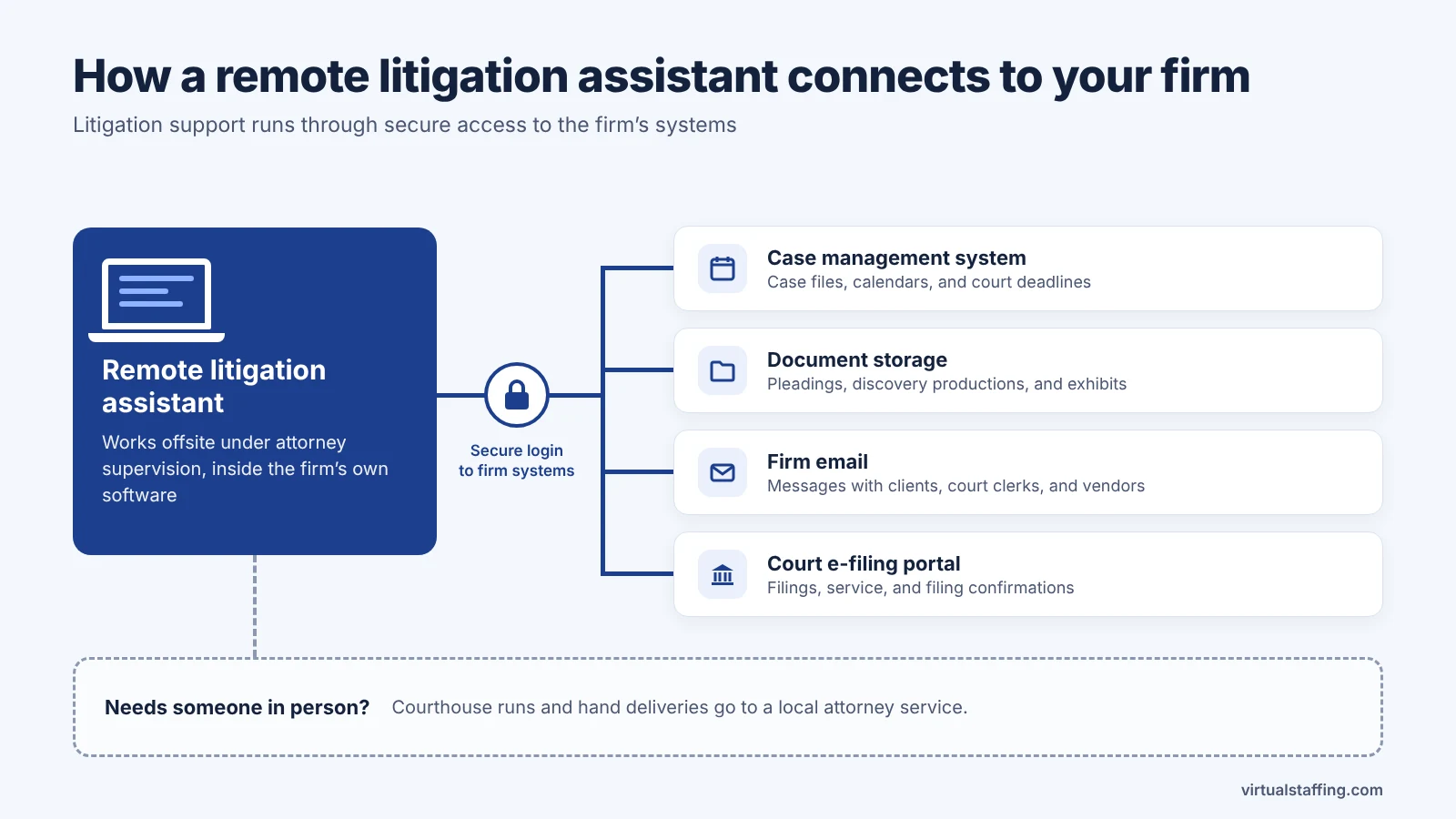
Yes, a litigation assistant can work remotely. Most litigation support happens inside software, not at a desk in the office. E-filing, calendaring, discovery tracking, and exhibit preparation all run through cloud systems.
A remote litigation assistant needs secure access to your case management system, document storage, and email. Firms that handle medical records should confirm their provider follows HIPAA-compliant processes for virtual legal staff.
Tasks that need someone in person, such as courthouse runs, can go to a local attorney service.
How to Hire a Litigation Assistant
The same steps apply whether you hire locally or remotely.
- List the tasks first. Write down the filings, deadlines, and discovery work you want to hand off. This shows whether you need an assistant or a paralegal.
- Decide between in-house and remote. Weigh your caseload, budget, and how much of the work needs someone in the office.
- Test real skills. Ask candidates to format a sample pleading or calendar deadlines from a court order.
- Check software experience. Confirm they have used your case management and e-filing systems, or can learn them quickly.
- Plan the first week. Give system access, templates, and a filing checklist. Set review points so an attorney approves work before it goes out.
Our step-by-step guide to hiring a virtual legal assistant walks through the remote hiring process in more detail.
FAQs About Litigation Assistants
1. What is a litigation assistant?
A litigation assistant is a legal support professional who helps attorneys manage lawsuits. They handle filings, deadlines, discovery documents, and trial preparation under attorney supervision. The role is also called a litigation legal assistant or litigation secretary.
2. What does a litigation assistant do?
A litigation assistant formats and e-files pleadings, calendars court deadlines, and organizes discovery. They also prepare exhibits, schedule depositions, and build trial binders. Their goal is to keep the case file complete and on schedule.
3. What is the difference between a litigation assistant and a paralegal?
A litigation assistant focuses on administrative and document support. A litigation paralegal handles more substantive work, such as legal research and drafting discovery responses. Both work under attorney supervision, and many small firms combine the roles.
4. Do you need a degree to be a litigation assistant?
No single degree is required to become a litigation assistant. Many firms hire based on legal administrative or law office experience. Some candidates also hold an associate’s degree or a paralegal or legal secretary certificate.
5. Can a litigation assistant work remotely for a law firm?
Yes, a litigation assistant can work remotely. Filing, calendaring, discovery tracking, and exhibit preparation all run through cloud-based systems. A remote litigation assistant needs secure access to the firm’s software. In-person tasks like courthouse runs can go to a local attorney service.